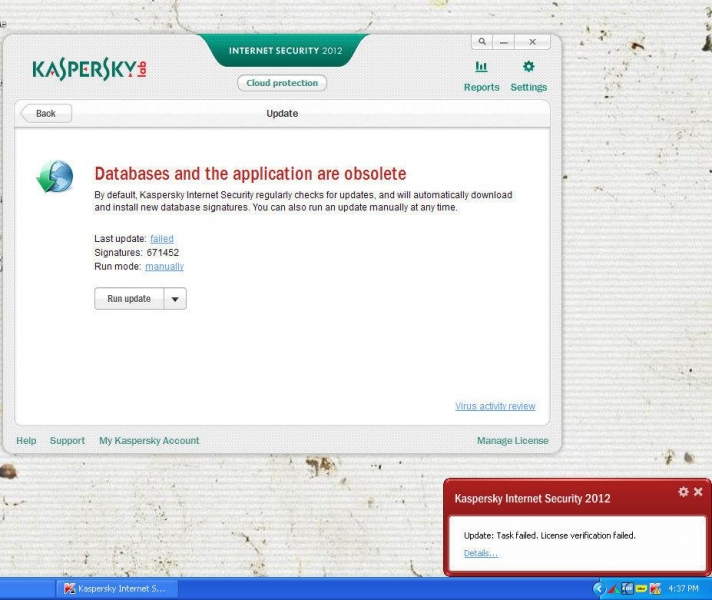
Data Bases Obselete But Update Fails At 78%25
- Data bases obselete, but update fails at 78%. Share this post. Bwelker bwelker Candidate; Members; 17 posts; Posted August 9, 2013. I get the same issue.
- In the WSUS Maintenance tab, select Remove obsolete updates from the WSUS database. The obsolete update removal will be allowed to run for a maximum of 30 minutes before being stopped. It will start up again after the next synchronization occurs. SQL Server permissions for removing obsolete updates.
D data definition language. Data dictionary. Metadata that keeps track of database objects such as tables, indexes, and table columns.For the MySQL data dictionary, introduced in MySQL 8.0, metadata is physically located in InnoDB file-per-table tablespace files in the mysql database directory. For the InnoDB data dictionary, metadata is physically located in the InnoDB system.
This was a tough one. We have labs full of Windows 7 computers thatget their updates via a WSUS server. These machines were not gettingtheir updates. Many of them were failing with WSUS error 0x80244010 .(There were some other errors as well, which I foolishly did not writedown.)
Error 0x80244010 means 'the client tried to contact the WSUS serverfor more than 200 round trips'.http://blogs.technet.com/b/sus/archive/2008/09/18/wsus-clients-fail-with-warning-syncserverupdatesinternal-failed-0x80244010.aspx. '200' is a hardcoded value. Re-running 'Check for Updates' on theclient several times (I have had to run it three or four times)can fix the issue well enough that the computer gets updates, but thisis irritating.
The underlying problem appears to be twofold:
- Every update on WSUS (even if they are unapproved) get theirmetadata sent to clients unless the updates are marked as expired.
- WSUS does not clean unneeded (obsolete? superseded? unapproved?) updates itself. I had beenrunning it as a 'fire and forget' server: allow it to autoapprovesecurity updates and then leaving it alone. This fills the databasewith a bunch of updates that gets sent out.
WSUS has a Cleanup Wizard which is supposed to expire obsolete andunneeded updates. I tried running this, but it would get stuck andhang forever.
There is lots of advice about how to fix this problem: defragging harddrives, running the Cleanup Wizard multiple times, running weirdPowershell scripts that launch the Wizard via the commandline. None ofthem worked for me. What worked was the advice on this page:
Although useful, note that the thread contains some unkind words toone of the thread participants. It also spreads out the advice I endedup using across the discussion.
The thread is full of good insight, and well worth reading. However, Ithought it would be helpful to consolidate what I ended up using tosolve our issue.
First, the problem: WSUS uses an internal database to store itsupdates. The Server Cleanup wizard calls a stored procedure whichtries to expire all old updates at once, and this times out and makesthe Cleanup Wizard hang. Usually, we want atomic all-or-nothingoperations in databases, so when the expiry times out the databasehelpfully rolls back expired updates, leaving us in the position westarted.
In addition to having too many updates it appears that certainobsolete updates have a large number of revisions, which also slowsthe clearout process down. Once these troublesome updates are expired,the rest of the cleanup can be handled relatively efficiently.
To solve the problem, you log into the database directly and run ascript that expires updates one by one. Troublesome updates take along time to expire, but they don't hit the timeout value, soeventually all updates get cleared.
Second: the steps. This boils down to running the following script,provided by user __Russ__ on the forums, based on code byvexation. (Sorry about the long line. I do not know how to safelyinsert linebreaks into the script and am not going to bother findingout.)
Download SQL Management Studio Express . We are running WSUS onServer 2008 R2, so I got version 2005, available here:http://www.microsoft.com/en-us/download/details.aspx?id=8961
Install SQL Management Studio Express and then start it asadministrator. Set theserver name to be
.pipeMSSQL$MICROSOFT##SSEEsqlquery. Apparently for Server2012 this should be.pipeMICROSOFT##WIDtsqlquery.Navigate to
Databases -> SUSDB.Make a 'New Query'.
Paste the script above into a query window.Then click 'Execute'.
Wait a long time. The script will tell you what it is doing in the'Messages' tab, which is helpful.
When the script has finished executing your WSUS installation should be clean.
Run the Cleanup Wizard regularly (I have decided to run it every twomonths) in a vain attempt to keep the database clean from now on.
Later in the thread there is some Powershell script that is supposedto do the same thing, but it did not work for me.
There a few takehome lessons for me from this:
Opaque software is terrible. The only reason people were able tosolve his problem was because WSUS (which I treat as a black box,since we auto-approve updates) actually uses SQL server secretly,and it is possible to connect to the SQL server directly and fixthings. If that SQL interface was not accessible we would all bestuck. I run into this issue again and again and again. Softwarethat you cannot troubleshoot and poke at is software you can't fix.
Similarly, uninformative progress bars that hide system problems areterrible. There should always be an option to see what the programis doing under the hood, if only so we can see whether the programis actually making progress. Progress bars lie.
Cooperative threads where people contribute and improve collectiveknowledge about problems are super-valuable, even when valuableinformation is smeared across the thread. I am so grateful thatthese sysadmins investigated the problem thoroughly and solved it,and I think Microsoft is as well: recently they published a longarticlehttp://blogs.technet.com/b/configurationmgr/archive/2016/01/26/the-complete-guide-to-microsoft-wsus-and-configuration-manager-sup-maintenance.aspxwhich FINALLY addressed this problem. I doubt they would have doneso if the above thread had not existed.
This kind of thread is probably not going to be successful onStack Overflow, because Stack Overflow expects fully-formedsolutions, not partial answers that work towards a solution. OverallI vastly prefer Stack Overflow results to the awful Microsoftforums, but in this case the Microsoft forum worked better.
WSUS is kind of terrible. I appreciate the declining individualupdates is a useful service, but I mostly want a stable, on-sitecache of Windows updates that our computers can use without taxingour external internet connection. But as updates get larger and morenumerous, WSUS is showing its age more and more. It is also notfire-and-forget software, which is really irritating. On the otherhand, WSUS is gratis with Windows Server. Having to purchase SystemCenter Configuration Manager to get a Windows Updates cache wouldbe worse.
Well first, let's take the first part of your rant../issue.


:no_upscale()/cdn.vox-cdn.com/uploads/chorus_asset/file/19486751/acastro_191211_3795_sidebar.jpg "Fails")
I'll take an exerpt from my up-and-coming blog post about how to setup, manage, and maintain WSUS..
WSUS Setup on Server 2012+Setup WSUS on Server 2012+ by first adding the role to the server through Server Manager. You can choose to use the Windows Internal Database (good for small to large deployments) or decide to use a Remote SQL server (Express, Standard or Enterprise) if you’re going to run a load balancing or high availability service. Most large organizations should use a distributed model for WSUS with a single master upstream server and multiple replica downstream servers based on location, bandwidth, or operational boundaries.
Databases Obsolete But Update Fails At 78% 2017
The Windows Internal Database (WID) is SQL Express edition, just built into the operating system as a feature, rather than having a separate installation. There is no benefit to installing a SQL Express instance locally on a system instead of using the WID. There is actually a detriment to installing SQL Express instead of using the WID; the SQL Express instance will have a hard limit for space in the database while the WID does not. The trade-off on using the WID is that it can only be accessed from the server itself (only through Named Pipes, and not from a remote server via TCP/IP)

Databases Obsolete But Update Fails At 78% Game
In almost all cases, the WID is the proper version of SQL to use as it doesn't have any limits of size.
As for your issue, you should be able to get SQL going again. First, install SSMS and connect to the SQL Database server. Since you're using express, you'll know the instance name if you gave it one, or it's the default SQLEXPRESS. Second, if your SSMS can connect and expand the database, then you can run WAM. WAM will remove a bit of data from the SQL database on the first pass, such that it will allow you back into WSUS. You may have to run WAM 1-15 times initially to start the cleanup process from the state that it's in.
After you're usable again, I'd recommend installing the WID role. Then you'll have to do some trickery with SSMS, the registry, and the files. First Stop the WSUS Service, Connect to the SQL Express database server instance and use a right click > properties and make a note of where the physical files are located (SUSDB.mdf/SUSDB.ldf). Right click the database and choose Detatch. This will detatch the WSUS Database from the Express version. Use file explorer and find the mdf/ldf files and copy them (not move) into C:WindowsWIDData. Once they are there, open SSMS up using Right Click > Run as administrator and connect to the database instance of: 'np:.pipeMICROSOFT##WIDtsqlquery' (assuming 2012+) with Windows Authentication. Now right click on Databases and choose Attach Database and find the SUSDB mdf/ldf files in the C:WindowsWIDData folder and attach them.
Now that you've moved the database, you have to tell the registry where the new database is located. Open Regedit and browse to HKLM:SoftwareMicrosoftUpdate ServicesServerSetup. Edit the SqlServerName to be : MICROSOFT##WID
Data Bases Obsolete But Update Fails At 78%25
Once you've done that, start the WSUS Services and WAM your server again using -FirstRun
From there, enjoy WSUS Freedom (and if you're not using SQL Express anymore for anything else, uninstall it as you don't need it taking up resources.)
Databases Obsolete But Update Fails At 78% 2016
Please have a look at the WSUS Automated Maintenance (WAM) system (New version coming June 1st). It is an automated maintenance system for WSUS, the last system you'll ever need to maintain WSUS!
https://community.spiceworks.com/scripts/show/2998-wsus-automated-maintenance-formerly-adamj-clean-w..
What it does:
1. Add WSUS Index Optimization to the database to increase the speed of many database operations in WSUS by approximately 1000-1500 times faster.
2. Remove all Drivers from the WSUS Database (Default; Optional).
3. Shrink your WSUSContent folder's size by declining multiple types of updates including by default any superseded updates, preview updates, expired updates, Itanium updates, and beta updates. Optional extras: Language Packs, IE7, IE8, IE9, IE10, Embedded, NonEnglishUpdates, ComputerUpdates32bit, WinXP.
4. Remove declined updates from the WSUS Database.
5. Clean out all the synchronization logs that have built up over time (configurable, with the default keeping the last 14 days of logs).
6. Compress Update Revisions.
7. Remove Obsolete Updates.
8. Computer Object Cleanup (configurable, with the default of deleting computer objects that have not synced within 30 days).
9. Application Pool Memory Configuration to display the current private memory limit and easily set it to any configurable amount including 0 for unlimited. This is a manual execution only.
10. Checks to see if you have a dirty database, and if you do, fixes it. This is primarily for Server 2012 WSUS, and is a manual execution only.
11. Run the Recommended SQL database Maintenance script on the actual SQL database.
12. Run the Server Cleanup Wizard.
It will email the report out to you or save it to a file, or both.
Although the script is lengthy, it has been made to be super easy to setup and use so don't over think it. There are some prerequisites and instructions at the top of the script. After installing the prerequisites and configuring the variables for your environment (email settings only if you are accepting all the defaults), simply run:
.Clean-WSUS.ps1 -FirstRun
If you wish to view or increase the Application Pool Memory Configuration, or run the Dirty Database Check, you must run it with the required switch. See Get-Help .Clean-WSUS.ps1 -Examples
If you're having trouble, there's also a -HelpMe option that will create a log so you can send it to me for support.